
A finite-kinematic route using reference coordinates and an StVK law for selected static serial solid cases.
01 Model and scope
The total-Lagrangian formulation integrates forces over the reference configuration. Green–Lagrange strain is objective under finite rigid rotation, and the StVK law applies linear isotropic elasticity to that strain. This combination has finite-kinematic terms but is only a simple verification material; it is not physically reliable for every large-strain response.
Read the kinematics, constitutive law and solution lifecycle together. A component's evidence does not qualify their combination.
Route assumptions and calculation checks
- Green–Lagrange strain retains quadratic displacement-gradient terms and is zero for a pure finite rigid rotation.
- StVK is linear in E but does not become a generally reliable material law at large strain merely because the kinematics are finite.
- The audited evidence is selected static serial TET4/HEX8, GO_WITH_LIMITATIONS, with no maturity promotion; contact, coupled J2, dynamics, MPI/PETSc, high-order, follower-load, and reduced/hourglass routes are excluded.
Useful foundations and prerequisites
02 Essential equations and symbols
Definitions and conventions
- Reference and current coordinates.
- Deformation gradient; J=det(F) must remain positive.
- Green–Lagrange strain measured against the reference configuration.
- Second Piola–Kirchhoff stress, work-conjugate to E.
- First Piola–Kirchhoff stress, used with reference gradients.
03 Step by step derivation
Follow the assumptions, equations and discrete operations in order. The full explanation stays visible.
In the v0.2.11 TET4 kernel, reference gradients form F, then E, second Piola stress S, first Piola stress P=FS, and internal force. A consistent tangent contains both material and geometric contributions. The separate static TET4/HEX8 audit remained GO_WITH_LIMITATIONS and did not promote maturity.
1 · Keep the reference configuration fixed
Total-Lagrangian integration stores the original coordinates X and reference volume Ω₀ throughout the solve. The deformation gradient maps reference directions to current directions. This choice makes the virtual-work integral independent of repeatedly rebuilding the integration domain in the deformed configuration.
The TET4 implementation rejects an inverted or singular current deformation as well as invalid reference geometry.
2 · Use Green–Lagrange strain for finite-rotation kinematics
The term FᵀF removes a pure rigid rotation because RᵀR=I. Expanding E shows both the linear symmetric-gradient term and a quadratic gradient term. That quadratic term is discarded by infinitesimal elasticity but retained here.
Objectivity of this strain measure does not make an arbitrary constitutive law objective by itself; stress measures and work conjugacy must also match.
3 · Apply the St. Venant–Kirchhoff material law
StVK is the finite-kinematic counterpart of a linear isotropic law written in Green–Lagrange strain. It returns second Piola stress S. The law remains linear in E, even though E is nonlinear in displacement; the global force–displacement relation is consequently nonlinear.
Here E_Y denotes Young's modulus; bold E denotes Green–Lagrange strain. StVK can predict poor or nonphysical behavior at large strain despite the exact finite-rotation kinematics.
4 · Push stress forward and assemble reference virtual work
Second Piola stress is work-conjugate to Green–Lagrange strain. The first Piola stress P=FS enters the reference-volume force integral. The consistent tangent separates a material contribution, which changes S with E, from a geometric contribution due to the current F and stress.
For the affine TET4 kernel, reference gradients and volume are constant. Higher-order or distorted element routes require their own integration and tangent evidence.
5 · Read the audit boundary
The source verification summary reports a bounded static serial campaign using selected TET4 and HEX8 StVK cases and records GO_WITH_LIMITATIONS; its final audit leaves maturity unchanged. The envelope excludes contact, coupled J2, dynamics, MPI/PETSc, higher-order elements, follower loads, and reduced/hourglass HEX8 variants.
A small geometric-nonlinear smoke example is deliberately WARNING. Treat it as an execution demonstration, not proof of convergence, physical validation, or qualification outside the recorded route.
04 Algorithm and implementation
Source excerpt · v0.2.11
The TET4 kernel evaluates Green–Lagrange strain and StVK second Piola stress, maps it to first Piola stress, and integrates force over the reference volume.
deformation = self.deformation_gradient(coords, displacement)
strain = self.green_lagrange_strain(deformation)
stress = self.second_piola_stress(strain)
first_piola = deformation @ stress
internal = volume * np.einsum('iJ,aJ->ai', first_piola, gradients).reshape(12)
tangent = self._consistent_tangent(deformation, stress, gradients, volume)
return internal, symmetrize(tangent)05 Verification and limitations
AUDITED GO_WITH_LIMITATIONS · maturity not promoted
The small geometric-nonlinear TET4 fixture is a smoke test and returns WARNING by design.
Each reference supports its own model, observable and analysis route. Read the original contract and limitations before transferring a conclusion.
See this method in a calculation.
Each case keeps its mesh, measured quantities, source record and limitations attached to the result.
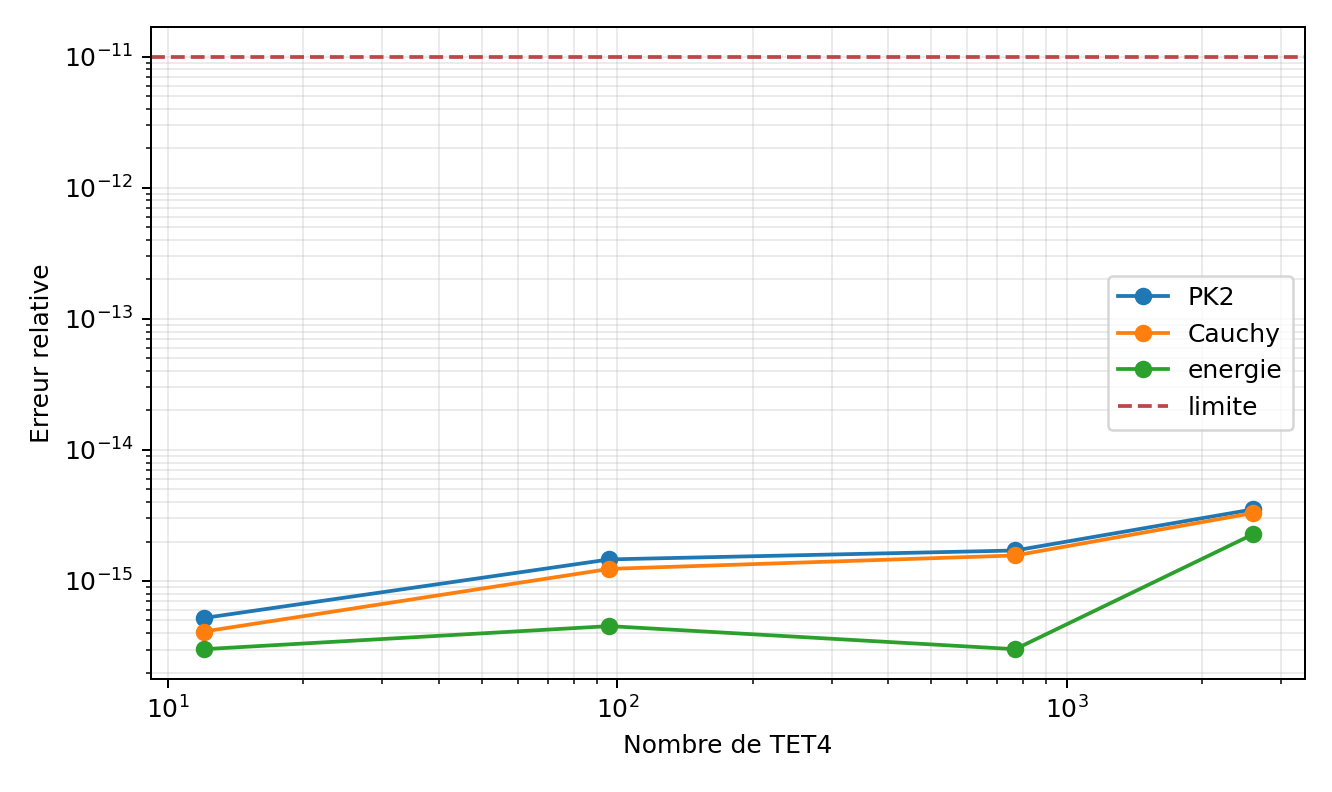 VNV-TET4-TL-STRESS-001TET4 affine finite-strain patchObserved patch error: ≈ 10⁻¹⁵Read model, result and limits →
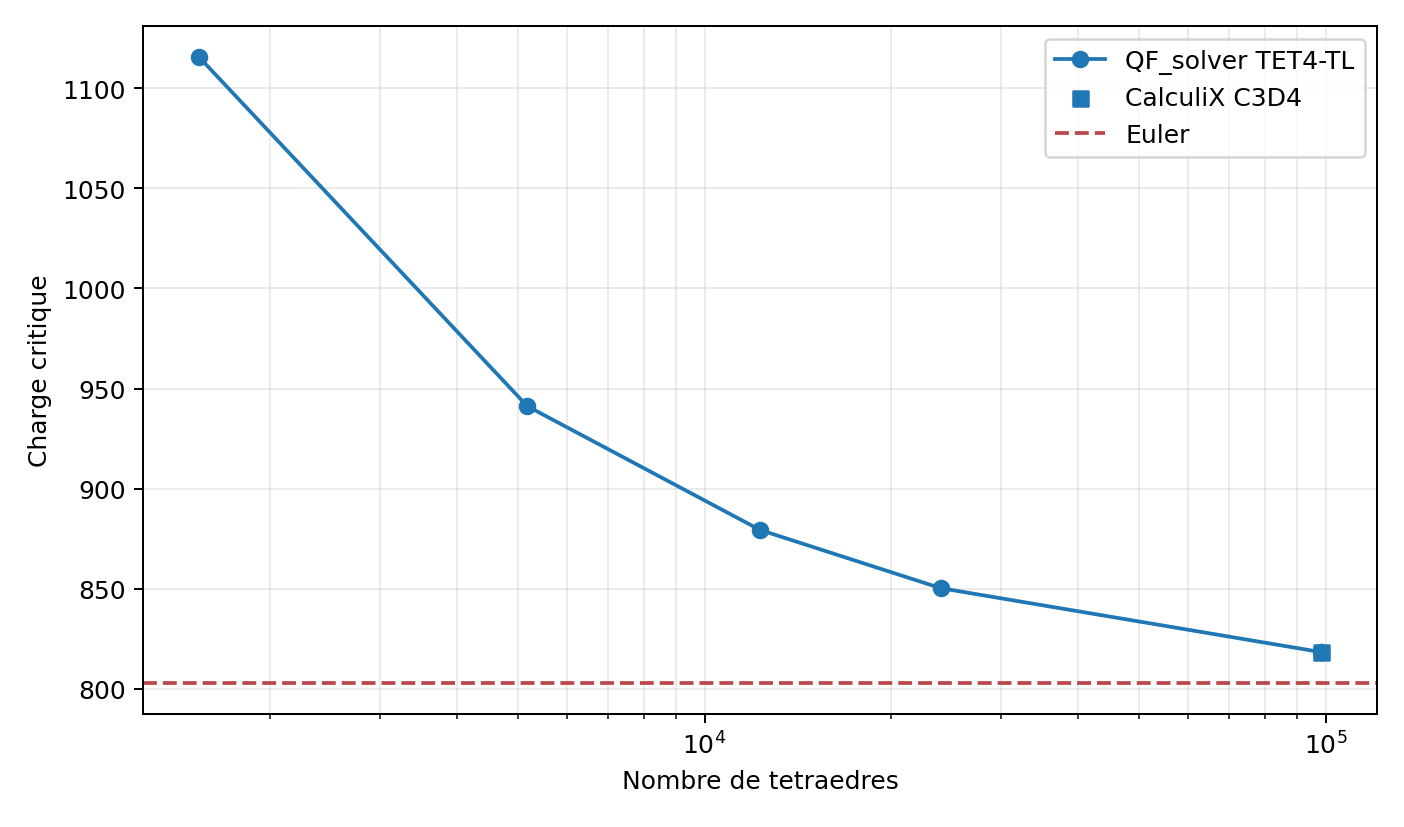 VNV-TET4-TL-BUCKLING-002TET4 linearized buckling refinementQF Solver critical load: 818.415402Read model, result and limits →
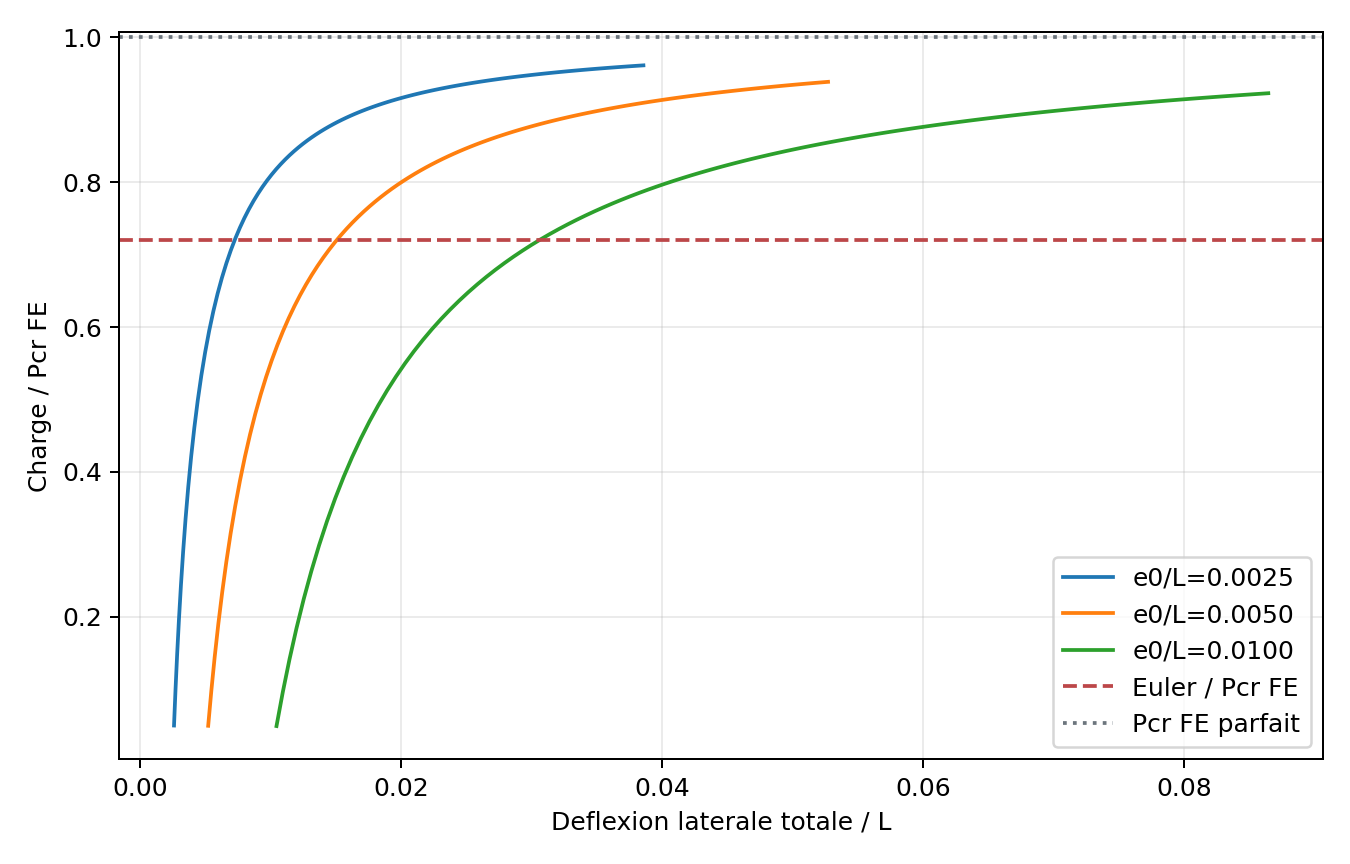 VNV-TET4-TL-POSTBUCKLING-003TET4 imperfect postbuckling pathsInitial imperfection amplitudes: 0.0025 / 0.005 / 0.01Read model, result and limits →