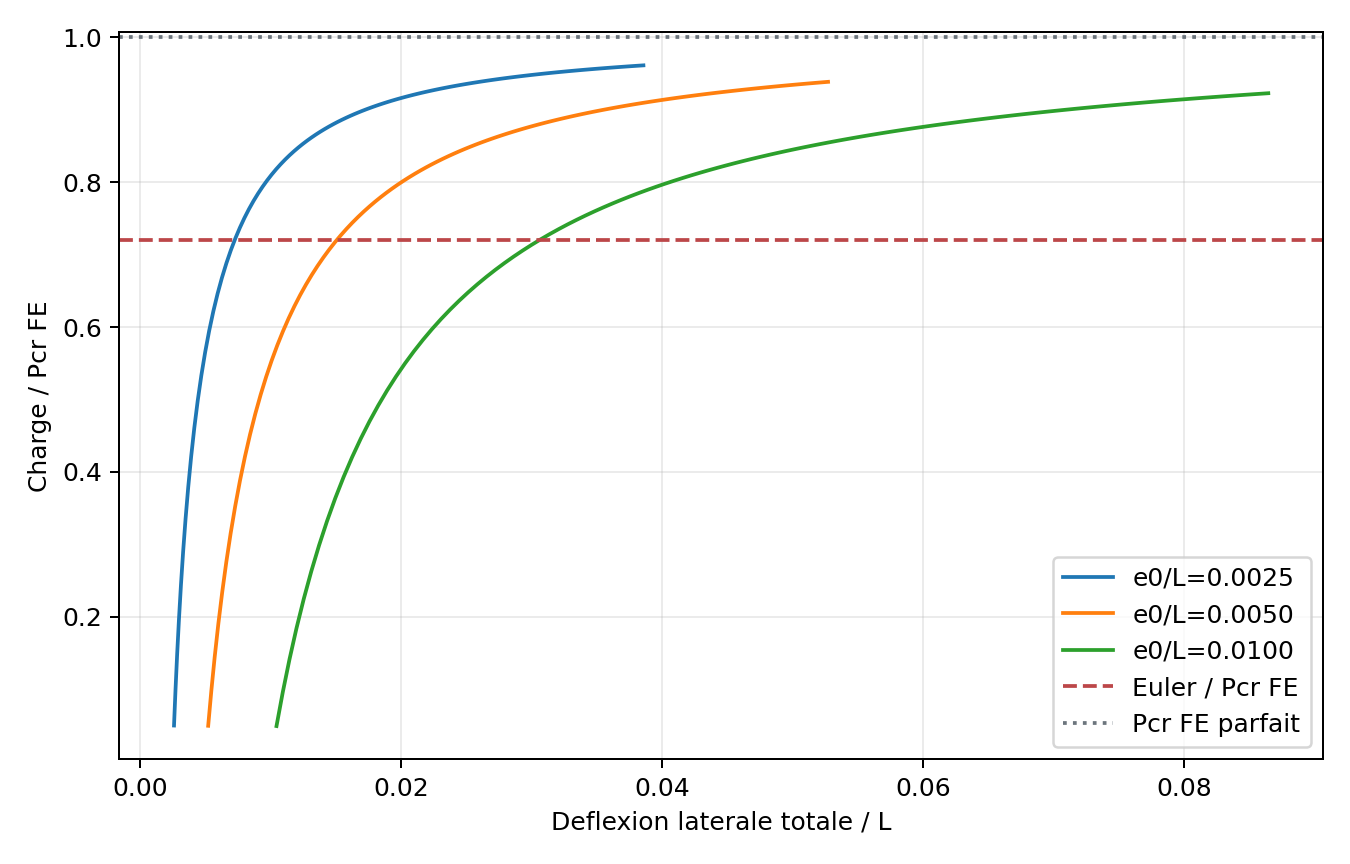
A consistent route tangent defines the Newton correction. A line-search factor may reduce a trial update when the residual does not decrease.
01 Model and scope
Newton linearizes the internal-force residual at the current trial displacement and solves for a correction. A line search tests a scaled correction when the full step fails to decrease the residual; convergence still requires the route's residual and increment criteria.
Route assumptions and calculation checks
- Stagnation and numerical residual floors are classified instead of treating every small update as convergence.
- Adaptive increments can cut back and retry after a rejected trial.
- A shared assembly interface does not mean every element/material/contact combination composes.
Useful foundations and prerequisites
02 Essential equations and symbols
Definitions and conventions
- Equilibrium residual at displacement u and load factor λ.
- Consistent route-specific tangent.
- Newton correction at iteration k.
- Accepted line-search scale between zero and one.
- r_{ref},u_{ref}
- Reference scales for residual and displacement tests.
- Route-specific residual and increment tolerances.
03 Step by step derivation
Follow the assumptions, equations and discrete operations in order. The full explanation stays visible.
1 · Define the equilibrium residual and route tangent
At a fixed load parameter, equilibrium is external force minus internal force. The tangent is the derivative of this residual for the exact selected element, material, and geometric route. A tangent from another route can converge slowly or converge to the wrong discrete problem.
2 · Compute the Newton correction
Linearize the residual at the current iterate and solve the tangent system for a displacement correction. In a full Newton step, the tangent is reevaluated as the state changes. Sparse factor reuse is valid only while the effective operator remains unchanged.
3 · Let the line search test a scaled trial
When the full correction does not reduce the declared residual merit, test a reduced step length η. The line search helps control overshoot; it cannot fix a singular tangent, an incorrect model, or a missing constitutive derivative. The exact acceptance rule is defined in the linked driver.
4 · Converge, cut back, or classify the stop
Require the route's equilibrium residual and increment criteria, not a small update alone. If an increment stagnates or fails, restore accepted material state and retry with a smaller load increment where supported. Numerical residual floors and iteration limits must remain distinguishable from convergence.
04 Algorithm and implementation
Read the linked versioned source for the actual assembly and solver behavior. The derivation above explains the mathematics and is not a verbatim source excerpt.
05 Verification and limitations
ROUTE-BOUNDED ROBUSTNESS TOOL · not a convergence guarantee
Each reference supports its own model, observable and analysis route. Read the original contract and limitations before transferring a conclusion.
See this method in a calculation.
Each case keeps its mesh, measured quantities, source record and limitations attached to the result.