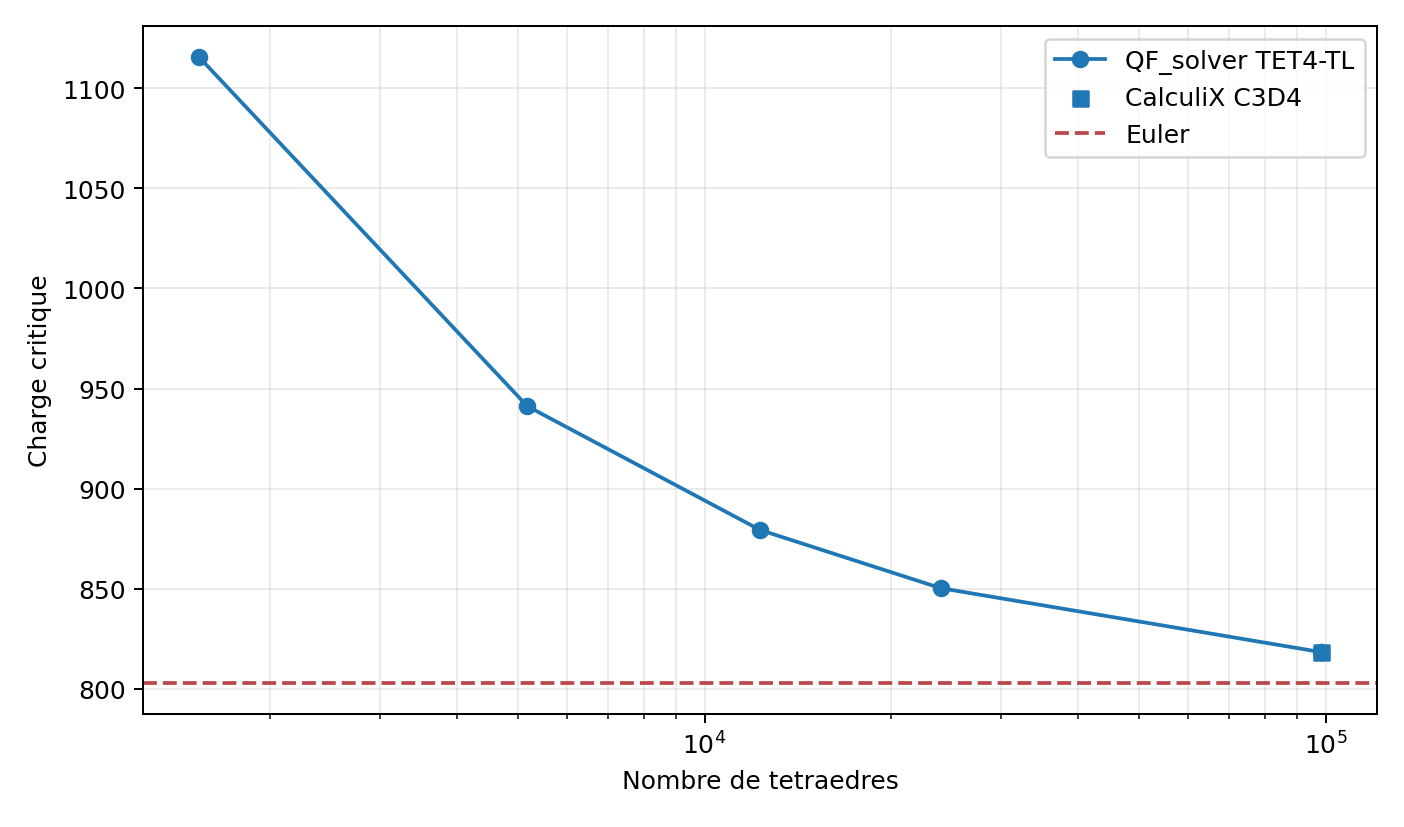
A converged preload is followed by an initial-stress decomposition and sparse generalized eigenvalue solve.
01 Model and scope
A proportional preload establishes a stress state, then a linearized tangent problem estimates the first load factor at which stability is lost. This is an eigenvalue prediction about that preload—not a traced nonlinear post-buckling equilibrium path.
Route assumptions and calculation checks
- The preload itself uses a bounded Newton route.
- The first factor and mode belong to the predeclared geometry, load, element, and prestress assumptions.
- No imperfection sensitivity, bifurcation handling, or general postbuckling path is implied.
Useful foundations and prerequisites
02 Essential equations and symbols
Definitions and conventions
- Elastic/reference stiffness contribution.
- Geometric or initial-stress stiffness contribution.
- Proportional load multiplier.
- Buckling eigenmode at the candidate factor.
03 Step by step derivation
Follow the assumptions, equations and discrete operations in order. The full explanation stays visible.
1 · Converge the declared preload state
First solve the nonlinear preload problem for its stated geometry, load pattern, material, and supports. The resulting stress state is the point about which the stability calculation is linearized. A failed or unconverged preload cannot define a meaningful critical factor.
2 · Form the route-specific stability pencil
Separate the tangent contribution associated with the reference configuration from the initial-stress or geometric contribution scaled by a load multiplier. The first candidate factor is where the constrained tangent becomes singular. The precise sign convention and matrices are those of the named implementation route.
3 · Extract and refine the first mode
Solve the implementation's generalized eigenvalue pencil on the constrained coordinates, order candidate factors, and refine the smallest admissible positive factor. Check the eigenpair residual and verify that its mode represents the expected instability pattern rather than a rigid or unconstrained mechanism.
4 · Interpret the factor as a linearized prediction
The eigenvalue scales the declared reference load under the frozen model assumptions. It is not a traced collapse load: imperfections, material evolution, contact, mode interaction, postbuckling, and imperfection sensitivity require separate nonlinear analyses and verification.
Read the linked implementation and HEX8 buckling record for the exact preload and pencil convention; this method card does not assert general postbuckling capability.
04 Algorithm and implementation
Read the linked versioned source for the actual assembly and solver behavior. The derivation above explains the mathematics and is not a verbatim source excerpt.
05 Verification and limitations
ROUTE-DEPENDENT · bounded first-factor cases
Each reference supports its own model, observable and analysis route. Read the original contract and limitations before transferring a conclusion.
See this method in a calculation.
Each case keeps its mesh, measured quantities, source record and limitations attached to the result.