
The 0.2.10 evidence includes bounded linear-static comparisons with Code_Aster 18.1 for named TET4, HEX8, TET10, and HEX20 cases.
01 Model and scope
A same-mesh comparison checks whether declared observables agree under matched geometry, material, loading and boundary conditions. It is a numerical correlation for those cases—not an independent physical experiment or a blanket solver ranking.
Route assumptions and calculation checks
- Compare coordinates, connectivity, materials, constraints, loads, output locations, and sign conventions.
- A small difference for one observable and mesh is not a universal accuracy statement.
- The whole-repository G03 archive gate remains failed; WP14 remains on hold.
Useful foundations and prerequisites
02 Essential equations and symbols
This sheet records a scope or execution boundary. Its detailed steps explain the relevant conditions.
Definitions and conventions
- Compared displacement observable.
- Compared stress observable where recorded.
- mesh/BC
- Mesh and boundary-condition identity that must match.
- Difference measured against the declared tolerance.
03 Step by step derivation
Follow the assumptions, equations and discrete operations in order. The full explanation stays visible.
1 · Make the comparison a same-problem comparison
Before comparing solutions, freeze coordinates, connectivity, material constants, supports, load resultants, units, solver assumptions, and output locations. Differences in any of these can dominate the solver discrepancy and make the comparison uninterpretable.
2 · Compare named observables with declared tolerances
Compare displacement, reaction, stress, or another explicitly recorded quantity at matched locations. Report the absolute and relative differences, the reference value, and the tolerance. Agreement in displacement does not imply agreement in stress recovery or every other output.
3 · Keep numerical correlation separate from validation
The 0.2.10 Code_Aster 18.1 comparisons cover named linear-static TET4, HEX8, TET10, and HEX20 cases. They are not independent experiments or a universal accuracy ranking. The repository's failed G03 archive gate and WP14 hold remain part of the evidence record.
04 Algorithm and implementation
This sheet provides explanatory references rather than an inline source excerpt. Use the labeled sources to inspect the precise boundary.
05 Verification and limitations
SAME-MESH NUMERICAL CORRELATION · not physical validation
Each reference supports its own model, observable and analysis route. Read the original contract and limitations before transferring a conclusion.
See this method in a calculation.
Each case keeps its mesh, measured quantities, source record and limitations attached to the result.
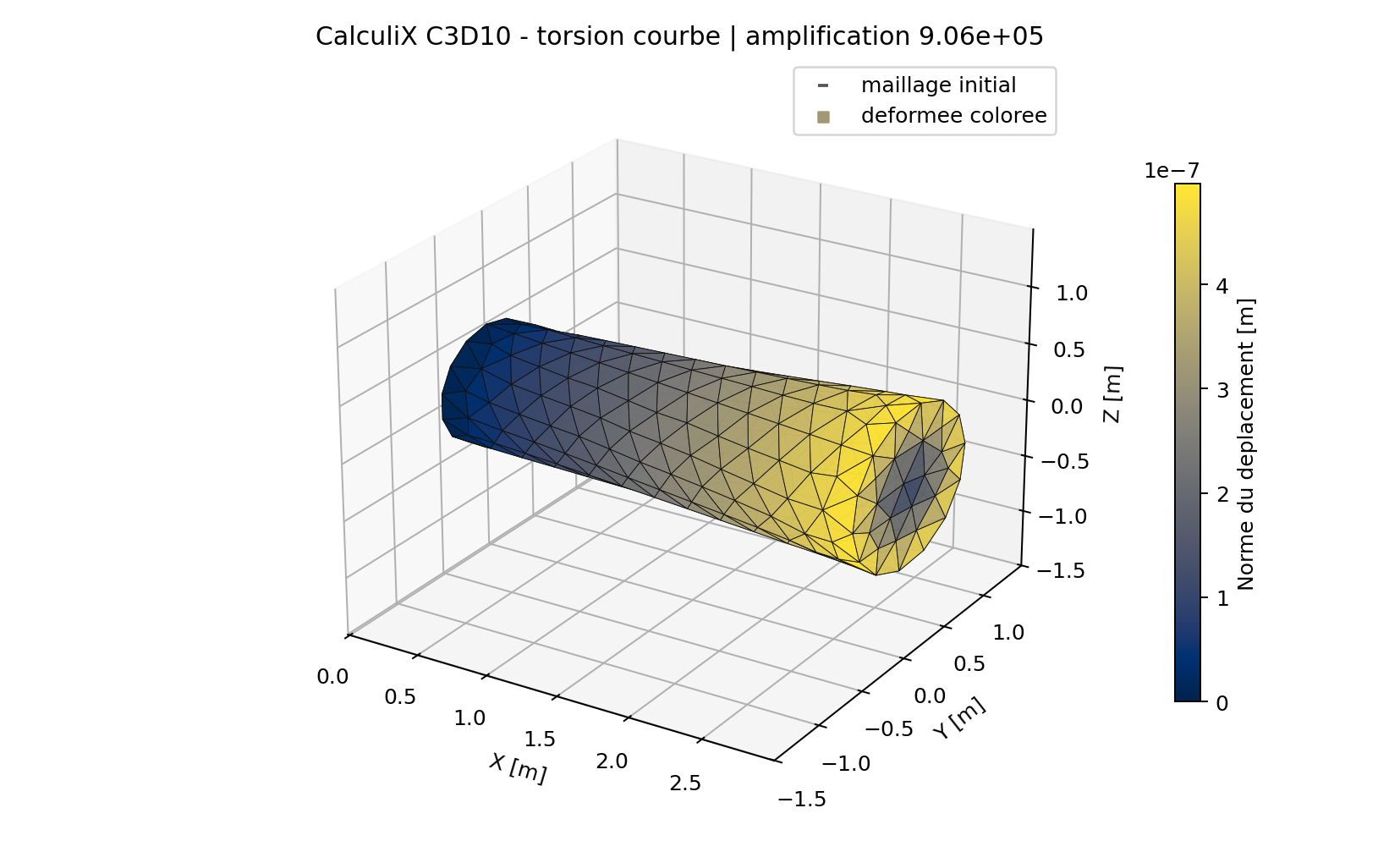 VNV-TET10-CALCULIX-C3D10-014TET10 torsion field correlation with CalculiXRelative full displacement field difference: 6.84 × 10⁻⁵Read model, result and limits →
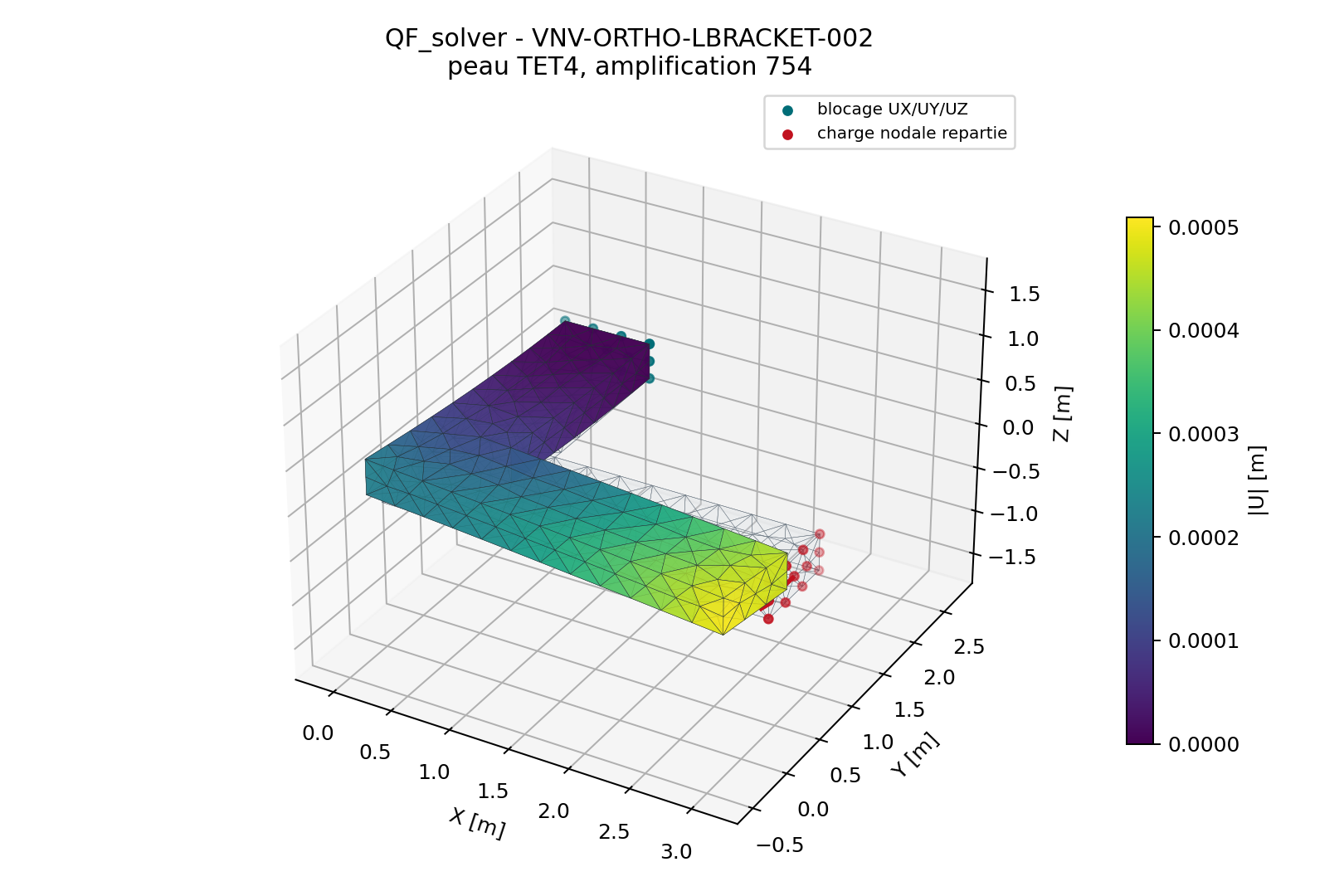 VNV-ORTHOTROPIC-SOLID-EXTERNAL-002Orthotropic bracket and perforated specimen correlationPerforated field difference: 0.000132% / 3.60 × 10⁻¹¹%Read model, result and limits →
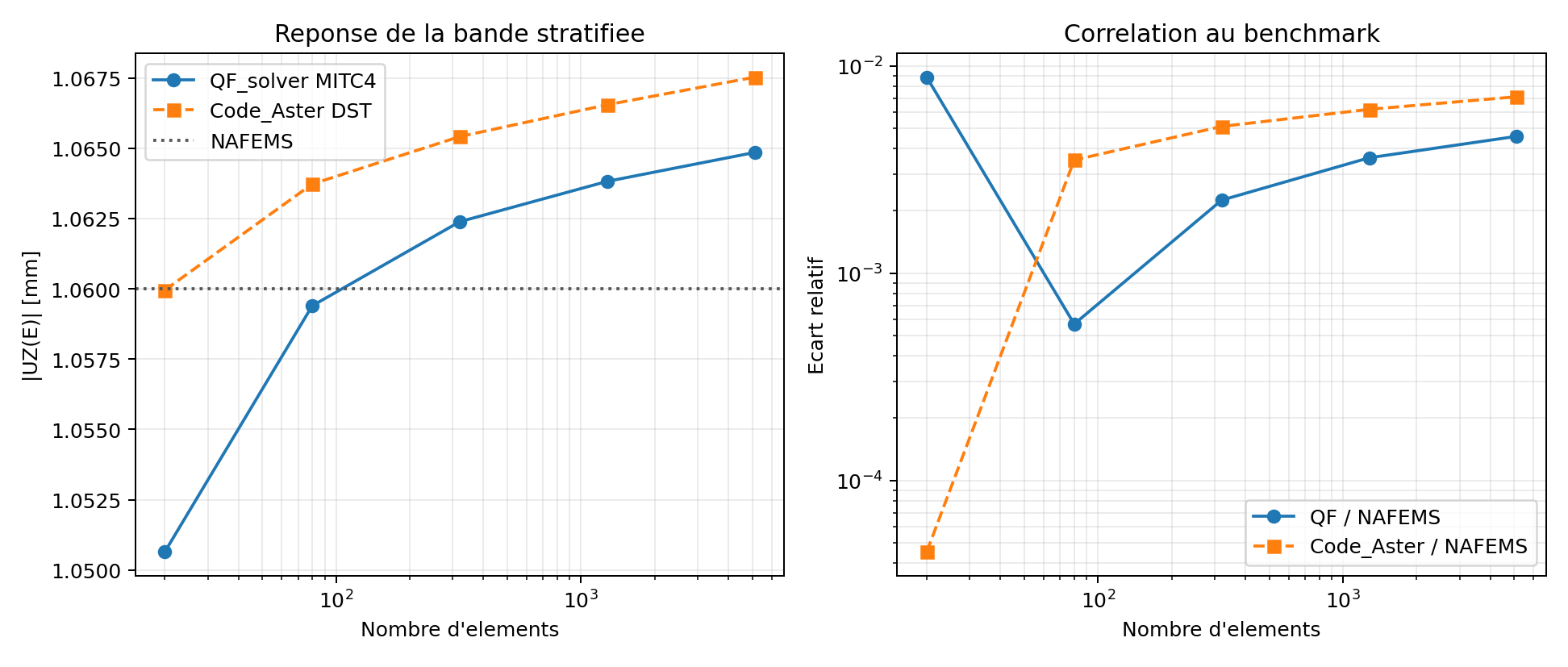 VNV-COMP-NAFEMS-R0031-CODEASTER-004NAFEMS R0031 laminated shell correlationQF Solver UZ at point E: −1.064851 mmRead model, result and limits →